
We are committed to complying with all applicable laws and regulations and acting in a fair, honest and ethical manner in our business dealings, engagements with one another, and our external stakeholders. In doing so, we not only mitigate the risks of potential non-compliance with laws and regulations, but also ensure the long-term sustainability of the group.
CORPORATE GOVERNANCE
Our group is overseen by strong governance structures, from the KAP board of directors to our divisional boards and management structures, as outlined in our corporate governance review on page 88, and governance framework, available on our website at www.kap.co.za. It sets out our framework for ethical business practices, governance, risk management and internal control. Our policies and procedures are set at a KAP level, which includes approval by the board, and adoption at a divisional level to ensure that we have high standards in place for core issues, such as ethics, anti-bribery and corruption, human rights and responsible tax practices. More details can be found in our corporate governance review, governance framework and group policies, available on our website.
Read more: Corporate governance review
COMPLIANCE WITH LAWS AND REGULATIONS
We have divisional compliance trackers to assess the status of legal compliance with applicable material legislation in relation to the operational activities at divisional sites. Any potential areas of non-compliance are reported at divisional audit and risk committee meetings and monitored at KAP compliance committee meetings.
We follow a robust process of reporting and mitigating environmental incidents, including any deviations from legal requirements. Our approach is based on an incident classification system, which includes assessing incidents based on their potential to create significant degradation or pollution of the environment. We collaborate with authorities on environmental inspections conducted at our sites. Our responses to findings include key remedial interventions aimed at sustaining compliance.
The group was compliant with all applicable material legislative requirements during the year.
ETHICAL CONDUCT
Our code of ethics
Our business conduct is underpinned by our code of ethics, which is explained to permanent employees during their induction and must be signed as a condition of employment. Our code of ethics deals with the core ethical principles of the group, which include compliance with laws, conflicts of interest, gifts, anti-bribery, political contributions, accurate financial record-keeping, ethical dealings, human rights and labour practices, health and safety, confidential and proprietary information, environmental stewardship and insider trading. Our code of ethics is supported by separate policies, including our human rights policy, ethics line policy, supplier code of conduct and environmental policy. These policies are available on our website and contain further details on what we deem acceptable and ethical behaviour in both our own operations and our supply chain.
Human rights
Our group subscribes to the principles of human rights as expressed through the following human rights standards and instruments:
-
The Bill of Rights in the Constitution of the Republic of South Africa (Chapter 2)
-
The UN Guiding Principles on Business and Human Rights
-
The International Bill of Human Rights
-
The International Labor Organisation’s Declaration on Fundamental Principles and Rights at Work
-
The Organisation for Economic Cooperation and Development Guidelines for Multinational Enterprises
-
The UNGC, of which we are a signatory
Our human rights policy encompasses the following human rights principles:
-
Non-discrimination: to prevent any form of discrimination or harassment based on race, religion, gender, colour, creed, age, political opinion and affiliation, social status, sexual orientation or disability.
-
Workplace health and safety: to ensure employees and contractors have a safe and healthy working environment.
-
Fair wages and compensation and standard of living: to provide employees with fair and competitive remuneration and benefit packages, relevant to the industries and territories in which we operate. Our workforce is entitled to breaks during working hours, paid leave and working hours within the legal limit.
-
No child labour or forced/bonded labour: to take all reasonable steps to verify the age of workers (including contractors) prior to employment. We have a zero tolerance for modern slavery, forced labour and human trafficking.
-
Freedom of association and collective bargaining: to allow employees to join trade unions and negotiate terms and conditions of employment.
-
Community engagement: to engage constructively and contribute positively to the communities in which our businesses operate. We respect the legitimate rights, interests and perspectives of indigenous peoples (generally accepted as those individuals who have historically occupied land) and consider their unique and special connections to land, water and other natural resources.
-
Prior to any material investment decision, we identify the key community opportunities and risks and, where appropriate, in conjunction with the community, develop strategies that mitigate risk and create opportunities for both the group and the relevant community.
-
Right to privacy: to respect the privacy of all individuals by complying with the applicable laws regarding the collection, processing, storage, use, retention, transfer, protection and deletion of personal data. We only process data lawfully and will only keep personal data for as long as is strictly necessary or legislatively required and for the purpose for which it was collected.
We require our suppliers to adhere to human rights principles, as outlined in our supplier code of conduct and included in all new contracts. We do not yet do audits to assess our suppliers’ adherence to our supplier code of conduct.
Read more: Human rights policy
Political contributions
Our code of ethics prohibits political contributions by the group to any political organisation. No direct or indirect contributions were made during the year.
Reporting and monitoring ethical or human rights concerns
We have an anonymous ethics line (web-based, e-mail and phone) through which employees, suppliers and the communities in which we operate can report illegal or unethical behaviour, including mismanagement, discrimination, harassment, vandalism, bribery, corruption, violence, theft and human rights abuses. The ethics line is independently managed and available 24 hours a day, seven days a week, available in all official South African languages during working hours (English outside of working hours). The ethics line is confidential and non-retaliatory and is available to both national and international callers. Ethics line activities are reported to our sustainability, social and ethics committee, audit and risk committee and the board.
The ethics line contact details are available on the landing page of our website and posters are displayed throughout the group, illustrating behaviours that should be reported and encouraging employees to make use of our ethics line.
Every reported incident is logged and investigated by an internal ethics panel. Where incidents are found to be valid, appropriate actions are taken and referred to law enforcement agencies in accordance with the law. The outcomes of the investigations are communicated internally and reported to the sustainability, social and ethics committee, the audit and risk committee and the board.
During the period, 84 ethics line cases were reported, compared with 59 in the prior year. We attribute the increase in cases to increased awareness of the whistle-blowing mechanism and employees wanting to work in an ethical work environment. Investigations have been concluded for 80% of the cases, of which 19% were found to be valid. Investigations into the remaining cases are ongoing. Although our code of ethics stipulates what is deemed ethical behaviour in the group, we have rolled out an ethics training programme across the group to give our employees practical examples.
ENVIRONMENTAL COMPLIANCE AND INCIDENTS
An environmental incident is an event that may cause harm or potential harm to an environmental receptor, such as air, water, land, wildlife or a local ecosystem; or where our operational practices do not comply with applicable environmental legislation, regulations, standards and applicable codes of practice.
We had three environmental incidents during the year:
-
PG Bison Mkhondo: Following a fire on site on 27 July 2024, discarded material was deposited in waste pits. Before the pits could be drained and cleaned, a blockage in the plant caused a large volume of effluent to be directed to the treatment plant, which drained into the already full pits, and then into the attenuation pond. This resulted in the discharge of contaminated wastewater from the pond into the downstream wetland. The Inkomati-Usuthu Catchment Management Agency issued a verbal directive to the site. All effluent discharge was immediately stopped and contaminated water was drained and disposed of at the municipal treatment plant. Additional storage tanks were installed to store excess effluent while additional waste ponds are under construction and rehabilitation started with planting of indigenous seedlings in the wetland. Regular compliance inspections are conducted by an independent party.
-
Unitrans: Following an accident, a truck’s fuel pipe was damaged, resulting in a diesel spill of approximately 500 litres into a nearby veld. Reporting in terms of section 30 of the National Environmental Management Act was done.
-
Vitafoam Durban (part of Sleep Group): A compliance notice in terms of section 31L of the National Environmental Management Act was served relating to the tank farm used to store chemicals for polyurethane foam production. This was replaced by a variation to the notice under which the site is not required to cease operation, but to comply with, among others, a submitted action plan to finalise an environmental impact assessment, and to make a section 24G application under the National Environmental Management Act. This application has been submitted.
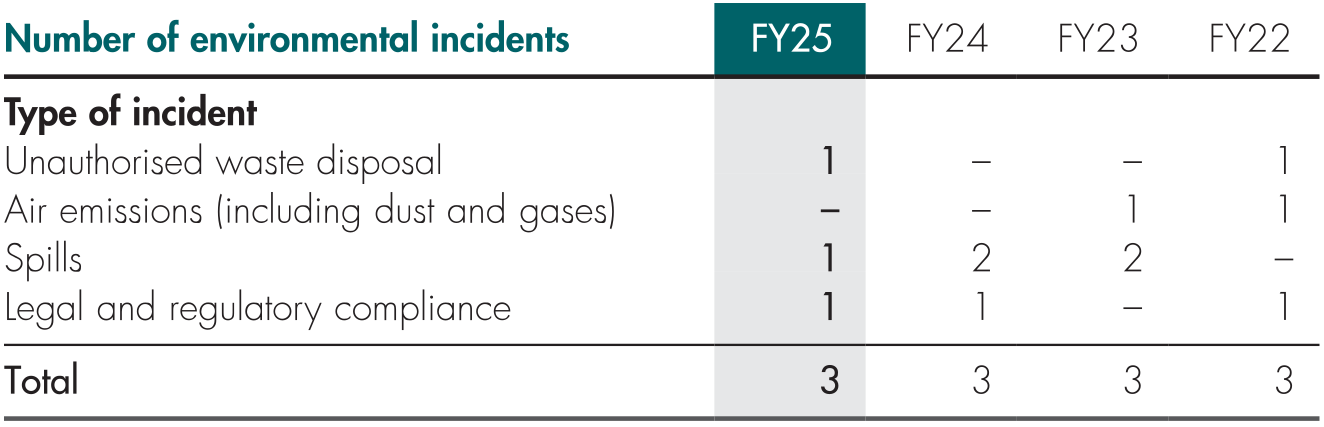
We prioritise the investigation of environmental incidents, followed by the implementation of corrective actions and the strengthening of the control environment. Where necessary, we use learnings to drive behavioural changes at an operational level. We treat incidents that are not resolved as ongoing matters, track the incidents in an environmental compliance register and address these at our divisional audit and risk committee meetings.
These incidents are also reported at the KAP compliance committee meetings with a view to ensuring oversight of actions taken.
RESPONSIBLE PROCUREMENT
We recognise the importance of sourcing materials and services responsibly, in line with our commitments to ethical labour practices, human rights and environmental performance. Our sourcing practices are guided by our supplier code of conduct, which sets out our principles and expectations regarding how existing and new suppliers of goods and services are to conduct business with us.
Our divisions include the supplier code of conduct in their suppliers’ contracts and some also include it in tender documentation or as an onboarding requirement.
SOUND TAX PRACTICES
Our tax strategy
Our tax strategy is to pay the correct amount of tax in the correct jurisdiction while remaining fully compliant with all applicable tax laws in each jurisdiction where the group operates. It is based on the following principles, which are set out in our group tax policy:
- Full compliance with all the tax laws applicable in the jurisdictions in which we operate.
- Ensure that tax is considered in all significant business and investment decisions, including consideration of available incentives and exemptions provided by governments.
- Foster constructive and transparent relationships with tax authorities.
- Avoid over- or underpayment of taxes by applying diligent professional care and judgement to ensure all decisions are well considered and documented.
Our tax strategy, as underpinned by our tax policy, is approved by our audit and risk committee.
Our approach to regulatory compliance
We seek to have and maintain professional, courteous, proactive, transparent and constructive relationships with tax authorities to minimise the extent of disputes, to achieve early agreement on disputed issues when they arise and achieve certainty, wherever possible.
We seek to provide quick, clear and reliable responses to queries raised by revenue authorities, creating an open communication channel and a cooperative atmosphere. Any errors in submissions made are addressed and fully disclosed to the revenue authorities as soon as reasonably possible after they are identified, once all facts have been established.
Where disputes cannot be resolved within the applicable dispute resolution framework, or justified from a commercial and economic perspective, we will pursue litigation.
Tax governance and control framework
Our board has ultimate responsibility for overseeing the group’s tax affairs, with operational responsibility delegated to our CFO, assisted by the tax executive. We manage tax in line with our combined assurance framework, following a risk-based approach and considering materiality levels approved by the board.
The centralised group tax function, reporting to our CFO, is responsible for providing operational guidelines aimed at ensuring a robust control environment, implementing risk management initiatives and supporting local management, who are responsible for everyday tax affairs, in all tax matters.
A tax compliance committee actively oversees, monitors and reviews the group’s compliance with the tax policy. The committee also assesses the potential effect that tax matters may have on the group’s profitability, reputation and sustainability.
Based on the combined assurance framework, a tax assurance framework was developed. The purpose of tax risk management is to identify and manage tax risks associated with the industries and territories within which the group operates to provide the board and KAP audit and risk committee with assurance that global tax risks are appropriately identified and managed and that any potential adverse tax consequences are minimised.
We are constantly building a culture of tax awareness within the group resulting in tax risks being identified and mitigating controls being implemented at an early stage. This is achieved through regular meetings between the tax executive and divisional CFOs and finance teams, as well as through regular group-wide tax-specific communication.
Our approach to public policy advocacy on tax
We are actively involved in the legislative process by commenting on new legislation and guidance issued by tax authorities and by lobbying for legislative change where required, either directly or through representative industry bodies.
Tax disclosures
Our tax disclosures are aimed at providing our key stakeholders with sufficient information to understand our approach to tax and the factors impacting the tax paid by the group.
Please refer to the group effective tax rate reconciliation included as note 10 in our FY25 AFS.


Extent of exposure to countries and jurisdictions recognised for their tax non-transparency and tax haven status
We have a presence in sub-Saharan Africa, Australasia and the United Kingdom. We are not present in countries and jurisdictions recognised for their tax non-transparency or tax haven status. Our operating companies are not present in Mauritius or Singapore. However, we own investment holding companies in these countries for expansion into Africa and other territories.
Government incentives
Through external service providers, the group avails itself of tax incentives provided by the South African government through special allowances in terms of the Income Tax Act, No. 58 of 1962 (“the Income Tax Act”).
The group benefited from the following incentives/allowances provided for in the Income Tax Act during the year:

ENVIRONMENTAL CERTIFICATIONS AND ACCREDITATIONS
PG Bison
- Our panel production lines are ISO 9001 certified.
- Our southern Cape and northeastern Cape plantations are accredited by the FSC (certificate numbers SGSCH-FM/COC-012032 and SGSCH-FM/COC-011207).
Safripol
- Our plants are ISO 9001, ISO 14001 and ISO 45001 certified.
- Our plants are Responsible Care® certified.
Unitrans
Unitrans has certifications and accreditations according to the standards for relevant industries/sectors in which it operates, including:
- ISO 9001, ISO 14001, ISO 45000, ISO 22000, ISO 9000 and NOSA.
- RTMS – Road Transport Management System for road-use self-regulation.
- AFMA – Animal Feed Manufacturers Association for agricultural transportation protocols.
- SQAS – CAIA accreditation for chemical transportation protocols.
Feltex
- Our plants have several ISO certifications and 15 of our plants also have IATF 16949 certification.
Sleep Group
- Our Restonic and Genessi product ranges are endorsed by the Chiropractic Association of South Africa.
- DesleeMattex products are ISO 9001 certified.